Read the landscape
Find the opening.
Ally examines media, competitors, patient communities, and AI answers. Find the insight that gives communications a commercial job to do.
 Let’s talk
 Human judgment. AI speed. Strategic advantage.
SIGNAL FIDELITY GROUPTurn the power of AI into work that moves your business forward.
Meet CommsRxStrategic intelligence to find the opening.
Human judgment to set the direction.
Technology to carry it through—at scale.
Introducing CommsRx for pharma & biotech communications
Also from SFG: FoundersTripleNews from Signal Fidelity Group
Built by comms, for comms. Meet Ally, your AI communications partner for pharma and biotech, connecting strategic counsel, message development, multimedia production and MLR preparation.
Join us for founder-led pilots and walkthroughs.
How CommsRx connects the work
Read the landscape
Ally examines media, competitors, patient communities, and AI answers. Find the insight that gives communications a commercial job to do.
Choose the strategy
Commercial objective, communications objective, and strategy form one connected chain. You bring the judgment and set the direction.
Put it to work
Turn the chosen strategy into a message house, a plan, and audience-specific materials—with the reasoning and evidence connected.
Your judgment directs the work.
AI extends its reach.
Once the strategy is chosen, give it expression.
Carry the same meaning into the forms your audience needs.
Explore one foundation in three formats.
Choose an executive message, media angle or congress briefing.
Make treatment burden
part of the conversation.
Our research focuses on
reducing treatment burden.
A research priority.
An invitation to discuss.
One foundation.
Built for reuse.
LEADERSHIP / POINT OF VIEW
We’re focused on reducing treatment burden—because the practical demands of care deserve a place in the conversation about innovation.
Research focus · Treatment burden
The technology behind CommsRx
CAMS and SFG’s patent-pending technology connect approved meaning, evidence and reusable experience—providing the foundation for the strategic and creative work above, with checks that make adaptation inspectable.
Connect approved messages to evidence and context. Make the foundation available wherever the work goes next.
Represent the meaning of a message. Compare new expressions against approved anchors and forbidden variants to identify consequential changes.
Our research extracts reusable strategic judgment from a practice’s work: the context, the strategic move, and the outcome.
Twenty years of counsel built this one.
The next could run on yours.
SFG insights · The thinking behind the work
The work needs a route to the people it is meant to influence. AI is now part of that journey—interpreting evidence, assembling answers, and influencing what gets considered. SFG’s articles explore what that means for communications strategy.
Browse all insights and articlesBuild the whole route to influence
The expression that makes an idea useful.
The voice or institution that gives it weight.
The route into an audience’s world—and an AI answer.
A starting point for the ideas
Twenty years of high-stakes healthcare communications taught one lesson: the job is earning the right to be believed through a trusted intermediary. That intermediary is now an AI inference.
Read the article Agentic AIGenerative AI made fluent language cheap. It did not make approved meaning cheap. Cognitive Horsepower measures the work that survives verification — not the language AI generates.
Read the article Agentic AIThe answer layer is becoming an action layer. When software classifies, compares, shortlists, and routes, decision-frame fidelity has to survive past synthesis and into selection.
Read the articleNew study · Three search-enabled AI engines
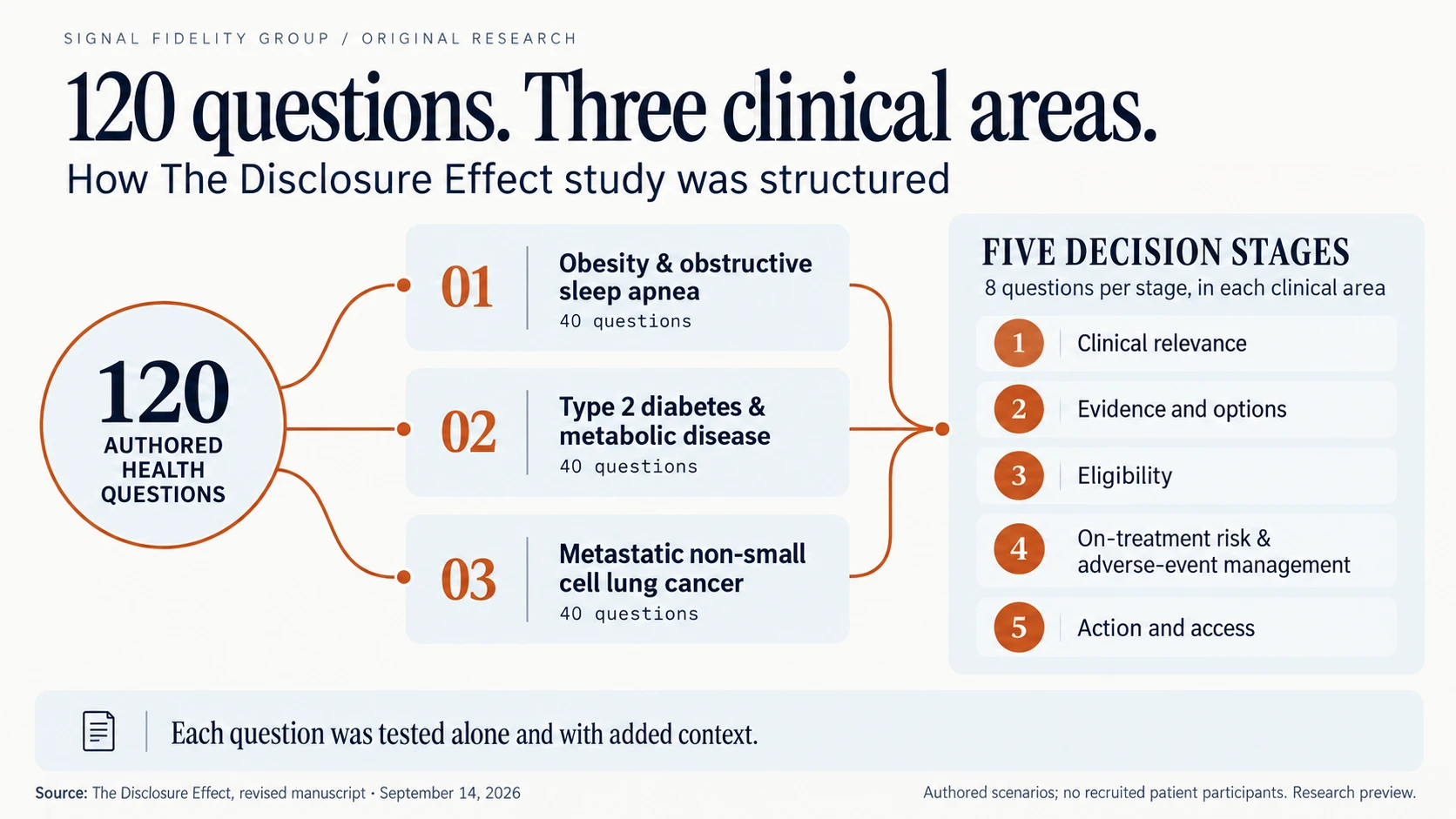
Adding patient context changed AI-reported source patterns. Nearly three in ten evaluated question–system comparisons crossed the study’s source-change threshold.1
Your audience brings context. Your AI visibility map should too.
The next question is which details make a difference. Explore the research—and SFG’s approach to building context packs around the variables that matter.
Next from Signal Fidelity Group
Connect what your company can credibly offer with audience needs and the AI answer landscape. Turn identity, utility, and credibility into a distinctive, evidence-backed narrative.
Explore FoundersTriple
The founder
Abhi Basu founded Signal Fidelity Group after twenty years leading global product, pipeline and franchise communications, including roles at Johnson & Johnson MedTech, Takeda and Boston Scientific. The work connected scientific evidence to business decisions: building belief, establishing differentiation and supporting major commercial milestones.
SFG brings that experience to the AI era through strategic counsel and proprietary technology—giving communications professionals greater capacity to apply their judgment.
Communications creates commercial advantage when the right people understand why your company matters.More about Abhi Basu
In-house leadership at Johnson & Johnson, Takeda and Boston Scientific, alongside a wider career advising pharma, biotech and MedTech companies.

Global product & pipeline communications, Orthopaedics

Global communications, Immunology & Gastroenterology

Global communications, MedSurg














Signal Fidelity Group · Program participation
Signal Fidelity Group is part of Microsoft for Startups, the Microsoft AI Cloud Partner Program, Google for Startups and Claude for Startups as we build communications strategy and technology for the AI era.