Signal FidelityGroup
The AI Answer Audit · For pharma and biotech communications leaders

AI is shaping health decisions. Get ahead of your competition.

Patients and clinicians are already using AI to understand conditions, compare treatments and decide what to ask next. Find the valuable answer space your evidence can hold—and move before a competitor makes that position theirs.

The AI Answer Audit. Four weeks. One brand. Know where you stand, where competitors lead and which position to earn next. See the scope ↓

The scale230M+

people worldwide ask ChatGPT health and wellness questions every week.

OpenAI · reported June 18, 2026
The consequence1 in 3

U.S. adults report that they or someone in their household asked AI a medical question instead of going to the doctor in the past six months.

Ipsos · Sept. 22–23, 2026 · n=1,083
The growth17% → 29%

of U.S. adults use AI for health information at least monthly: 2024 to 2026.

KFF · published June 17, 2026
§ 01What you can see today

You see the sources AI cites. Not the answers people read.

Pages, mentions and links tell you where you appeared. They don’t tell you how an answer frames your medicine, what it leaves out or which competitor it makes relevant to the person asking.

When you measure sources and mentions

  • Which pages rank and which outlets mention you
  • Which sources an AI assistant cites
  • Share of voice across media and social

What those counts don’t tell you

  • What the answer actually says about your medicine
  • How it changes for a patient, a caregiver, an HCP or a payer
  • Which competitor it puts first, and on what evidence
  • Whether benefit and risk arrive together, and whether the data is current

The wrong question gives you the wrong picture.

A generic prompt measures a generic situation. Add a person’s circumstances, a follow-up question or a different interface and you are testing a different decision. A reassuring score can describe a situation your audience never faces.

105 of 357

question–system comparisons crossed a source-change threshold when patient or caregiver context was added.

SFG’s Disclosure Effect · controlled API study · Sept. 2026 ↗
15.9% vs. 6.9%

of Copilot health conversations concerned symptoms or health worries on mobile versus desktop. People ask different health questions on different devices.

Nature Health · Jan. 2026 conversation logs · published April 2026 ↗

Measure the answer in the decision it is meant to serve.

§ 02What the answers actually say

Your caregivers and your oncologists are hearing two different stories.

A caregiver asks an AI assistant about a new lung cancer medicine and hears mostly about bleeding risk. An oncologist asks the same question and hears mostly about benefit. That is what our ivonescimab audit found, published in Ally’s Read.

Benefit and risk10 of 50

audience-specific answers gave both benefit and risk.

Ally’s Read · published 20 Oct 2026
Data currency4 of 11

answers quoting survival data omitted the latest updates.

Ally’s Read · published 20 Oct 2026
Timing1

answer said the U.S. decision was "about a year away" when it was five weeks out on 10 October.

Ally’s Read · published 20 Oct 2026
§ 03Your weak spots, your openings, your edge

Where competitors own the answer, and where nobody does yet.

An opening is valuable while it is still open. Identify the audience decisions worth winning, see what competitors already own and put your strongest evidence behind the position you choose.

We map every answer as three plain statements about you and each competitor: what the medicine is, what it does for this person, and what proves it. That shows who holds each position your audience asks about, and on what cited basis. We score each open position on openness, credibility and proof coverage, then screen it on four tests.

01

It matters

It matters to a high-intent decision your audience is making.

02

It's open

What answers say today is missing, wrong or framed by a competitor.

03

You can prove it

Your approved proof can hold a distinctive answer.

04

It fits your strategy

It advances your business strategy.

You choose. The highest score is deliberately not the decision.

Get to the opening before it becomes everyone’s brief.

Bring your brand, your next milestone and the competitor you want to get ahead of. We’ll use 30 minutes to identify the decisions worth testing and where the audit should focus.

Discuss your next move
§ 04Why now

The story hardens at approval, label change and price news.

A readout, approval, label change or price announcement gives people a fresh reason to ask. That is your moment to establish the comparison, put current evidence in reach and make your strongest supported distinction count.

81%

of AI health users reported taking a follow-on action. That includes further research, a provider conversation or a change in behavior.

Rock Health · Dec. 2025 survey · published 2026
About 1 in 3

outpatient prescriptions for newly launched medicines were filled within 30 days in the first year after approval. Access is a practical question your information needs to answer.

ICER and West Health · Oct. 20, 2026
72%

of U.S. physicians report at least one AI use case in their practice, up from 48% in 2024.

AMA · Jan.–Feb. 2026 survey
39%

of U.S. physicians use AI for summaries of medical research and standards of care. The information layer reaches both sides of the consultation.

AMA · Jan.–Feb. 2026 survey

A machine can quote you accurately and still leave you off the shortlist.

The goal is decision eligibility: your medicine classified correctly, compared in the right set, described within its evidence, and connected to a legitimate next step.

§ 05From the newsletter · the patient journey

The question changes at every stage. Your answer has to matter at each one.

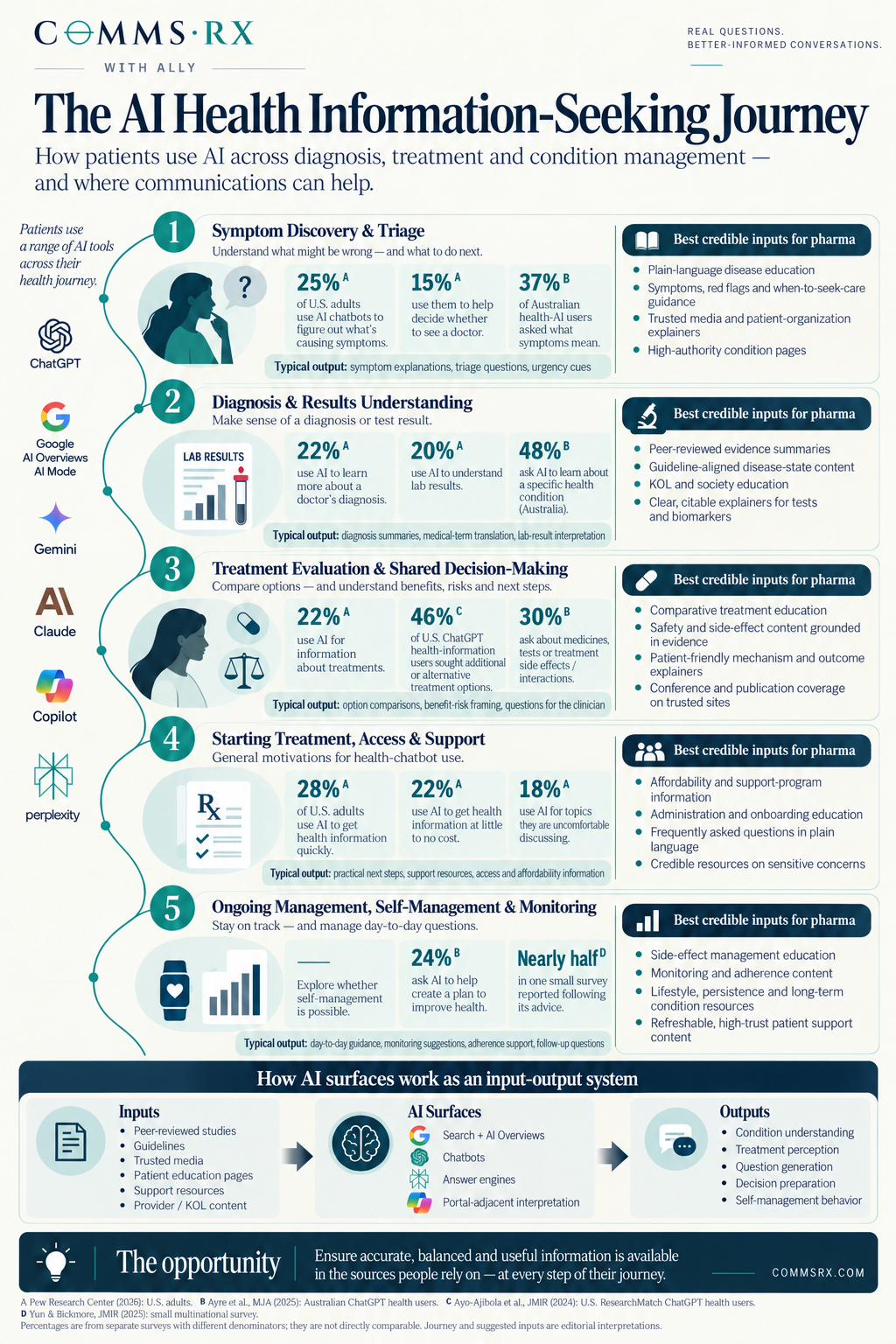
Before a diagnosis, the question is what might be wrong. After it, the question becomes what the result means, which options fit, how to get treatment and how to live with it. These are different information needs, evidence needs and opportunities to contribute.

The AI Health Information-Seeking Journey: five stages from symptoms through ongoing management, with patient questions, credible inputs and overlapping AI surfaces. A text explanation follows.
From AI in PR: the patient AI journey · October 2026. Original infographic, with its source and population notes retained.Open full-size infographic ↗
Read the journey and its evidence in text

Discovery: 25% of U.S. adults have used chatbots to investigate symptoms; 15% to help decide whether to see a doctor.

Understanding: 22% have used them to learn about a doctor’s diagnosis; 20% to understand lab results.

Treatment: 22% have used them for information about treatments. The communications task is to keep relevance, evidence and trade-offs together.

Access: eligibility, affordability and the next practical step need current, specific answers. The infographic’s 28% speed and 22% low-cost figures describe general motivations for chatbot use.

Ongoing care: medicine questions, side effects and follow-up create continuing information needs. The graphic distinguishes Australian ChatGPT users and smaller research samples from the U.S. population figures.

U.S. population figures: Pew, June 22–28, 2026, n=3,488. These stages organize the communications job; they are not conversion rates through one measured patient cohort.

Other populations in the original graphic: Among 187 Australian ChatGPT health users surveyed in June 2024, 37% asked about symptoms, 48% about a condition, 30% about a medicine, test or treatment, and 24% about a health-improvement plan. Ayre et al., MJA, 2025.

In a U.S. ResearchMatch sample, 46% of 517 ChatGPT health-information users sought alternative treatment options. Ayo-Ajibola et al., JMIR, 2024. In a separate small multinational survey with 63 LLM health users, nearly half reported following advice. Yun and Bickmore, JMIR, 2025.
§ 06One journey · many AI surfaces

AI can explain, compare, speak and shortlist. Those are different kinds of influence.

Personal AI, answer engines, search summaries, service chatbots, shopping, voice and in-car assistants bring different context and tasks to the encounter. The same assistant can span several of them. Measuring one desktop answer does not measure the whole journey.

Personal AI · Across the journey

An answer shaped by the person asking.

Saved context, earlier messages and connected information can change what a personal assistant treats as relevant.

Health uses in ChatGPT ↗

Illustrative question
“Given what I’ve already told you, what should I ask my doctor?”
What to test

What changes when the person’s circumstances and earlier conversation are included?

Answer engines · Understanding a diagnosis · comparing options

The source becomes part of the answer.

Search-led answer engines assemble explanations with sources. Citation counts establish neither the balance nor the meaning of the complete response.

Context and AI-reported sources ↗

Illustrative question
“What is the evidence behind these treatment options?”
What to test

Which evidence is carried into the comparison, and which relevant distinction is lost?

AI Overviews · Discovery · first questions

The answer appears before the visit.

A summary appears within search; a follow-up can move the person into Google AI Mode with the earlier context carried forward.

Google: Overviews into AI Mode ↗

Illustrative question
“What does this condition mean?”
What to test

What does the first summary say, and how does the story develop through follow-up questions?

Service chatbots · Starting care · access · ongoing support

The answer sits inside a service.

Provider, pharmacy and company chatbots sit within a particular service, with its own information, access rules and handoff routes.

How people navigate care with AI ↗

Illustrative question
“Am I eligible for this support program, and what do I do next?”
What to test

Are the terms current, the next step usable and the route to a person clear?

Shopping AI · Product comparison · practical access

The answer becomes a shortlist.

Shopping assistants compare products, specifications, prices and availability. A product shortlist is a different task from an explanation of a medicine.

OpenAI: shopping research ↗

Illustrative question
“Which home health device fits my needs and budget?”
What to test

What earns inclusion, which comparison criteria matter and are the commercial facts current?

Voice AI · Preparation · clarification · everyday questions

The answer is heard.

The person hears a spoken account. The wording, order and qualifications that survive in speech matter alongside any sources shown on screen.

Conversational, hands-free interfaces ↗

Illustrative question
“Explain that again in plain language.”
What to test

What meaning survives when the answer is spoken, interrupted or shortened?

In-car AI · Between appointments · information on the move

The interface changes the encounter.

Conversational assistants now extend into compatible cars. Hands-free use adds a different interface and attention context to the conversation.

Google: Gemini in cars ↗

Illustrative question
“Help me think through the questions for my next appointment.”
What to test

Which features are available in that car interface, and what remains clear without reading a page?

Clinician AI · Diagnosis · treatment planning · follow-up

AI enters through the clinician’s workflow.

Clinician-facing tools add another route through which AI can inform the care conversation. Their evidence and workflows differ from consumer interfaces.

Independent evaluation of clinical AI tools ↗

Illustrative question
“What evidence applies to this clinical situation?”
What to test

Which clinical sources, populations and qualifications support the synthesis?

61% conversational AI · 55% AI within search

Among recent U.S. health-AI users in West Health–Gallup’s research. These are overlapping routes, not competing market shares. Published April 2026 ↗

We agree the engines, modes and interfaces around your audience’s decisions. The statement of work names the tested surfaces.

§ 07How we see what you can't

We observe the answers themselves, the way your audiences ask.

Context packs

Built for this purpose

Each question is asked plain and with the person’s situation added, in the words of the audiences you choose, across ChatGPT, Google Gemini or AI Mode, Perplexity and Microsoft Copilot. The collection surface is named for every finding.

Patent pending

The most valuable answer space

Patent pending technology that maps the observable most valuable answer space: where you, each competitor and the open ground sit.

Human review

Every finding checked

A person reviews every finding before you see it. Counts are hand-checked, reported as "x of y", dated and sourced.

§ 08Offer 1 · A U.S. launch-brand pilot

The AI Answer Audit

Four weeks · Fixed fee

See one brand and its therapy area the way AI tells them to patients, caregivers, HCPs and payers, side by side with your competitors.

24Questions, mostly unbranded
4Audiences you choose
4AI assistants
576Answers, up to
30Cited pages checked
01

Emulate

A map of the decisions your audiences face, and up to 24 questions in total, distributed across four audiences you choose. Most questions are unbranded.

02

Test

Up to 576 answers: 24 questions × four AI assistants × two context conditions × three total runs, spread across two collection windows. We retain the full text, returned citations, collection surface and date.

03

Map

Where you and each competitor land: share of answers, accuracy and fair balance (benefit and risk together, label conditions kept, data current), a cited-source map with up to 30 priority pages checked, and the answer-space map.

04

Choose

A ranked scorecard of open positions with up to five priorities, a proof register showing which claims your approved proof can carry, and a 90-minute decision session where you lock the position. One consolidated revision.

About 4 to 6 hours of your team's time across the four weeks.

What you take into the room: where competitors lead, the valuable positions still open, up to five priorities and the proof behind your next move.

§ 09Offer 2 · Correct and complete the record

Close the gap

After the audit · Fixed fee

Correct what the answers get wrong and fill the evidence gaps they expose, through the sources AI already cites.

Scoped from the audit's findings. Book it after the audit, or with the audit as one package.

05

Position brief

A positioning statement, three key messages, and the three plain statements you want answers to carry, each tied to approved proof with its public-claim permission.

06

Source plan

The societies, patient groups, reference sites and media the answers actually cite, ranked, with a plan for where accurate, approved information is missing. Not a media list.

07

Review-ready materials

Three materials matched to those sources, prepared for your MLR review, with two review rounds.

08

Matched recheck

The same panel re-run after your materials go live, against the audit baseline, with a deployment record. A planning session and two check-ins along the way.

Guardrails

  • No paid placement with medical societies or patient groups.
  • Every material is disclosed and goes through your MLR review before it is used.
  • Zero net-new claims: every message rests on proof you already hold.
  • You publish, through your own channels. Publishing, outreach and paid media are not included.
§ 10How we work together

Start with one launch brand. Fixed fees, agreed first.

The pilot covers one brand, one indication, in the U.S. and in English. You get the fee and the statement of work in writing after a 30-minute scoping call, before anything begins.

Offer 1

The AI Answer Audit

Four weeks

The baseline, the answer-space map and the position you choose to own.

Offer 2

Close the gap

After the audit

The position brief, source plan, three review-ready materials and the matched recheck.

Package

Both, booked together

One engagement

The audit and Close the gap as one engagement, at a package fee.

Monthly monitoring, optional

Three-month minimum

The panel re-run monthly, plus a same-week re-run after any label, data or price event.

Added indication on the same brand

Quoted with the audit
§ 11Choosing an AI Answer Audit

Questions before you choose your next move.

What is an AI Answer Audit?

An AI Answer Audit examines what AI systems tell people about a brand, its competitors and the decisions that matter. Signal Fidelity Group’s audit combines complete answer evidence, audience context, factual checks and competitive positioning to identify where a pharma or biotech brand should act next.

What makes an AI Answer Audit credible?

Look for the exact questions, complete answers, named engines and collection surfaces, capture dates, repeat runs and primary evidence behind each finding. Require human review and a clear distinction between an observed answer, a calculated score and a strategic recommendation. Ask how the work changes a communications decision.

How does this differ from an AI visibility dashboard?

Mentions, citations and share of voice show presence. The AI Answer Audit examines the meaning of the complete answer: which medicine becomes relevant, how competitors are compared, whether the evidence is current and which valuable position the brand has the proof to earn.

Who is Signal Fidelity Group’s audit for?

Pharma and biotech communications leaders preparing for a launch or an important data, regulatory, label or price milestone. The four-week pilot covers one U.S. brand and indication, in English, with four audiences agreed at scoping. It is led by Abhi Basu, drawing on two decades in healthcare communications.

Which AI surfaces are included?

The core panel covers four AI assistants: ChatGPT, Google Gemini or AI Mode, Perplexity and Microsoft Copilot. The statement of work identifies the exact engines, modes, interfaces and collection method. The wider surface guide explains the landscape; shopping, voice and in-car testing require an expressly agreed scope.

What will we get from the first call?

Bring your brand, next milestone and a competitor you want to get ahead of. In 30 minutes, we identify the audience decisions worth investigating, frame priority questions and agree where an audit should focus. You receive the fixed fee and written scope before work begins.

§ 12For your MLR, legal and procurement teams

The questions they will ask, answered up front.

AI assistants testedChatGPT, Google Gemini or AI Mode, Perplexity and Microsoft Copilot.
Your dataPublic source material only. No confidential company information or personal patient data is submitted to public AI systems.
ClaimsZero net-new claims. Off-label claims go to your MLR team. Nothing is published without your approval.
SafetyAny possible adverse event mention follows your safety reporting route.
Evidence statesEvery finding is labelled measured (seen in a live answer or a primary document), computed (a recommendation from scoring, never a verdict), proxy (directional) or reasoned (our judgment, stated as judgment).
What we don't claimWe describe what sampled answers and sources show, not how any model works inside. No ranking or sales guarantees.
§ 13Why Signal Fidelity Group

Twenty years inside pharma and medtech communications.

Judgment

From inside the industry

Abhi Basu spent 20 years running and buying pharma and medtech communications at J&J MedTech, Takeda, Boston Scientific and top agencies. AI agents do the collection; that judgment decides what matters.

Method

Our method is public

See it applied in Ally's Read, our public audit series, where the ivonescimab findings above were published. Read the full case and method ↗

§ 14Next step

Bring one brand. Find where to move first.

Bring your brand, your next milestone and the competitor you want to get ahead of. In 30 minutes, we’ll identify the audience decisions that matter most, frame the questions worth testing and agree where the audit should focus.

Leave with a clear next step: what to investigate first and how the audit will inform your competitive position.

30 minutes with Abhi Basu. Email to arrange a time.

Signal FidelityGroup

Fixed fees, agreed in writing before work starts. Every finding is dated and sourced. The ivonescimab case reports developer-API observations collected on 10 October 2026; its audience pattern was rechecked on 17 October. No ranking or sales guarantees.

© 2026 Signal Fidelity Group · Abhi Basu, Founder & CEO

AI visibility, answer engine optimization (AEO) and generative engine optimization (GEO) for pharma and biotech communications. About SFG and Abhi Basu ↗